AI May Democratise Intelligence. But Who Will Own the AI Economy?
- Sep 2026
- 102
- 0
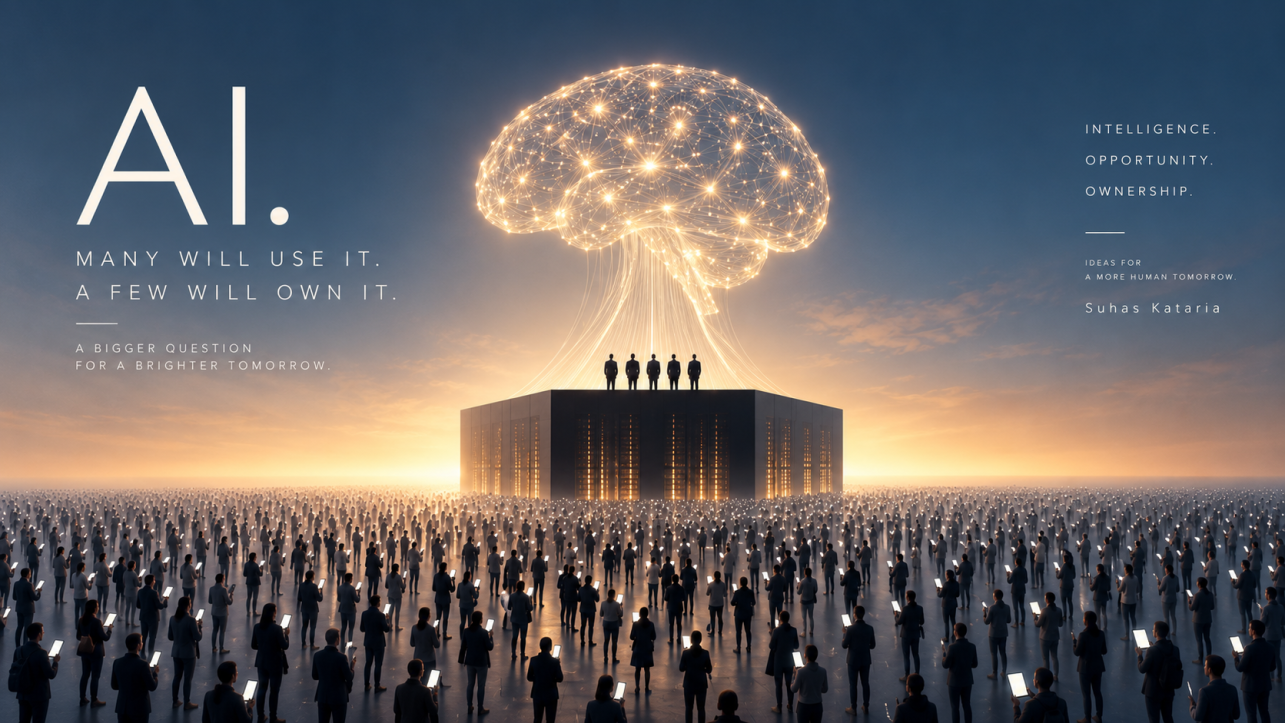
The artificial intelligence revolution could make sophisticated intelligence available to billions of people. But the extraordinary wealth being created around AI points to a different question: access may become widespread while ownership remains remarkably concentrated.
The AI economy is the ecosystem of physical and digital assets required to build, operate and distribute artificial intelligence, including energy, data centres, semiconductors, compute, models, data, applications and distribution.
The latest numbers give us a powerful starting point. Altrata's Billionaire Census 2026 reports that the world's billionaire population reached a record 3,795 people in 2025, while their combined wealth climbed 12.8% to an unprecedented USD 15.1 trillion.
Artificial intelligence was an important part of that story. Among the 150 listed companies that contribute most to billionaire wealth, companies making meaningful investments in AI saw their market capitalisations grow 23% faster over 2024-25 than those that did not.
But I think the more interesting story is not billionaire wealth. It is ownership.
Because every major technological revolution eventually creates two groups: those who use the technology, and those who own the assets underneath it. And AI may be creating that divide remarkably quickly.
We Are Asking the Wrong AI Question
Most conversations about artificial intelligence currently revolve around usage. Which AI should I use? Which model is better? How do I automate my company? Will AI replace my job? How do I become more productive and AI-ready?
These are important questions. But there is another question that entrepreneurs, investors and business leaders should probably be asking:
What part of the AI economy do I own?
That distinction could become enormously important. Using technology creates productivity. Owning strategically valuable parts of its ecosystem can create wealth.
History has demonstrated this repeatedly. Industrialisation created enormous wealth for those who owned factories and manufacturing capacity. The automobile economy rewarded ownership of manufacturing, oil, infrastructure and distribution. The property economy rewarded ownership of scarce land. The internet created enormous fortunes around platforms, networks, marketplaces and digital distribution.
AI could follow a similar pattern. Except the assets may look different.
The AI Ownership Stack
I think it is useful to stop thinking about AI as a single industry. Instead, think about an emerging AI Ownership Stack. At different levels sit:
- Energy
- Data Centres
- Chips
- Compute
- Models
- Data
- Applications
- Distribution
Not every layer will capture value equally. And the winners within those layers will change. But this framework reveals something important.
AI isn't merely software
It is an enormous new economic infrastructure. AI requires electricity. It requires physical data centres. It requires semiconductors. It requires enormous computing capacity, which is why AI infrastructure companies like Neysa matter so much. It requires models. It requires proprietary datasets, and the knowledge engineering and domain graphs that make them usable. It requires applications. And eventually it requires access to customers.
Some of the world's most valuable companies are already positioned somewhere within this stack. Google's USD 75 billion AI push and Databricks' USD 250 million India investment are both bets on specific layers of it.
Which means the AI revolution is simultaneously a software revolution, infrastructure revolution, energy revolution and capital-allocation revolution.
Millions Will Use AI. Far Fewer Will Own Its Infrastructure.
This is where things become interesting. Generative AI could eventually put extraordinarily sophisticated intelligence into the hands of almost anyone with a connected device. A student. A designer. A doctor. A broker. A programmer. A small-business owner. A farmer. An entrepreneur.
That is genuinely democratising. But the infrastructure producing that intelligence may remain much more concentrated.
Altrata's numbers provide an interesting signal about concentration more broadly. Just 29 people worth more than USD 50 billion each held approximately USD 4.1 trillion in 2025, which is 27% of all billionaire wealth. In 2017, people above that USD 50 billion threshold represented only 7.2% of billionaire wealth.
That does not mean AI alone caused this concentration. Equity markets, monetary conditions, existing business ownership and many other forces matter. But AI is increasingly becoming one of the engines amplifying the value of certain companies and assets. And that leads to a paradox worth watching:
AI may democratise intelligence while simultaneously concentrating ownership of the infrastructure producing it.
Access Is Not Ownership
The internet taught us this lesson already. Billions of people gained access to information. But enormous economic value accrued to companies controlling search, social networks, commerce, operating systems, cloud infrastructure and digital advertising. Users received extraordinary utility. Owners captured extraordinary economics.
AI could produce a similar dynamic. Billions may interact with models every day. But underneath those interactions will be chips, servers, data centres, energy networks, models, proprietary data, cloud infrastructure, applications and distribution channels. Someone owns each of them.
This is also where Jevons Paradox and the AI boom come in: as intelligence gets cheaper, demand for the underlying infrastructure tends to grow, not shrink.
That is why I believe the next phase of the AI conversation will gradually move from adoption to ownership.
The Entrepreneurial Opportunity Is Much Bigger Than Building Another AI App
This distinction matters particularly for entrepreneurs. Right now, thousands of companies are putting an AI interface over an existing workflow. Some will become excellent businesses, and it is clear why VCs are betting big on AI application startups. Many will disappear as foundational models absorb their functionality.
The more durable question is: what do you own that becomes more valuable as AI becomes more powerful?
Perhaps it is proprietary data. Perhaps a specialised workflow. Perhaps distribution into an industry. Perhaps deep domain expertise embedded into software. Perhaps infrastructure. Perhaps a trusted community. Perhaps physical assets AI depends upon. Perhaps an industry-specific dataset competitors cannot easily reproduce.
Perhaps the answer isn't technology at all. It could simply be a customer relationship that AI makes dramatically more valuable. This is one reason top tech leaders are leaving C-suites for AI ventures: they want to own a piece of the stack, not just operate inside it.
The moat may not be the AI. The moat may be what you own around the AI.
This Matters for Real Estate Too
My own work sits at the intersection of technology, digital discovery and real estate, which makes this development particularly fascinating. Because the AI economy eventually becomes physical.
Data centres require land. Compute requires enormous amounts of power. Power requires infrastructure. Employees require housing. New technology clusters create commercial activity. Infrastructure creates new economic corridors. And economic corridors reshape property values.
So even something that appears completely digital eventually interacts with geography. We often describe AI as living "in the cloud". The cloud, however, sits on very expensive land filled with very expensive machines consuming very real electricity.
That is why the AI revolution shouldn't only interest technologists. It should interest investors, real-estate developers, infrastructure companies, energy businesses, governments, entrepreneurs, and anyone thinking seriously about where economic value may accumulate over the next decade.
From "How Do I Use AI?" to "Where Do I Sit in the AI Economy?"
I believe this is the mindset shift worth making. The first stage of the AI revolution was fascination. The second was adoption. We are now entering optimisation, driven by agentic AI and autonomous systems. But eventually comes something more fundamental: economic positioning.
Individuals will ask how AI makes them more productive. Companies will ask how AI changes their margins. Entrepreneurs will ask what new businesses become possible. Investors will ask where returns accrue. Governments will ask which infrastructure must be built. And increasingly, everyone will have to understand where they sit in the AI value chain.
The winners won't necessarily be the people who use the most AI tools. They may be the people and companies that own something increasingly valuable because AI exists.
The Question Worth Asking
The AI revolution is still young. Today's leaders may not be tomorrow's. Models will commoditise. Compute costs will change. New architectures will emerge. Regulation will evolve. And today's extraordinary AI valuations may prove justified, excessive, or some combination of both.
So I wouldn't look at today's billionaire rankings and conclude that the future has already been decided. Quite the opposite. We are probably still early enough that entirely new layers of the economy are being created. That is exactly why future-backward thinking in the age of AI is so useful right now.
Which makes this an unusually important moment to ask:
If AI becomes one of the foundational technologies of the next 30 years, what will you own because of it?
Because millions, and eventually billions, of people may use artificial intelligence. The much smaller group that owns valuable pieces of the economy underneath it may experience an entirely different revolution.
And perhaps that is one of the biggest business stories hiding inside the AI boom. Whether that turns out to be a blessing or a beast depends largely on who ends up owning what.
Source: Altrata, Billionaire Census 2026.

Comments
No comments yet.
Add Your Comment
Thank you, for commenting !!
Your comment is under moderation...
Keep reading blog post