The Business of Bhakti - Why India's Devotional Music Keeps Earning After the Festival
- Nov 2026
- 90
- 0

From a five-billion-view Hanuman Chalisa to ticketed kirtans, devotional music shows what happens when listeners have a reason to come back. The hard part is turning all that attention into revenue.
In 2025, the Hanuman Chalisa drew one and a half times as many streams on JioSaavn as the title song from Saiyaara, one of the year's biggest film hits. On Tuesdays, a day traditionally associated with Hanuman worship, JioSaavn reported a 35% lift in Hanuman Chalisa streams. Both figures come from JioSaavn's own data, published in the 2026 FICCI–EY report. I find the Tuesday number more revealing. The calendar can do some of the work a release campaign usually has to do.
There is a longer version of that story on YouTube. T-Series uploaded its Shree Hanuman Chalisa, sung by Hariharan and featuring Gulshan Kumar, in May 2011. In November 2025, it became the first Indian video to cross five billion YouTube views. Those views accumulated over more than fourteen years, as a recording from the cassette era found new listeners on a video platform.
A recording can have a place in someone's day before a platform ever recommends it. A household starts its morning with an aarti. A community sings a familiar bhajan at a festival. Someone who has moved abroad presses play and hears the voice they grew up with. The business begins with those reasons to return. The question is who can earn from the listening, and what people will pay for when the music itself is freely available.
The calendar brings listeners back
Ganesh Chaturthi gives Ganpati aartis a place in homes and pandals. Janmashtami brings Krishna bhajans into family celebrations and congregational singing. In festive-season data reported in 2026, Spotify India said devotional listening rose 13%, with devotional tracks tending to play in the morning and party playlists taking over later in the day. The same household can supply demand for both. For a label, the festival offers a window to introduce a new arrangement or revive an older recording that people can return to once the celebrations are over. Brands and publishers already plan around this rhythm, as seen in how GenAI transformed e-commerce this Diwali and in Zomato's Mission Diwali campaign.
The weekly and daily patterns matter just as much. A person looking for the aarti they grew up hearing may remember the opening line, a singer's voice or the tempo more clearly than the album title. That has practical consequences for how labels publish music. Titles in the original script and in Roman transliteration, clear performer credits, lyrics and versions suited to the occasion all help a listener find the recording they meant to play, which is the same discipline behind any SEO and AI optimization guide for content professionals. A short clip can introduce the voice, much like top-of-funnel content in a comprehensive guide to TOFU, MOFU and BOFU. The complete, clearly credited version is what a listener can save and sing along to next week.
The language matters because the repertoire is local. A Marathi abhang and a Telugu Annamacharya keerthana carry different literary and musical histories, and an audience familiar with either may care about diction or phrasing that an outsider would miss. Tirumala Tirupati Devasthanams has a dedicated Annamacharya project that supports performances in temples, music sabhas and other institutions. The Sikh tradition of Gurbani kirtan has its own institutions and purposes, including the SGPC's live broadcast from Sri Harmandir Sahib. Both examples show how cultural institutions sustain access to sacred music alongside commercial distributors.
Why labels buy recordings people already know
The cassette helped make this business possible. In Cassette Culture, ethnomusicologist Peter Manuel describes how inexpensive cassette technology opened Indian music distribution in the 1980s to hundreds of local producers. Recordings could travel well beyond the place where they were made. Digital platforms extended that reach and made old recordings searchable alongside new ones. A label with a strong catalogue can introduce the same repertoire to several generations through different formats, from the original album to a restored recording or a festival compilation.
The value of regional repertoire showed up in a deal in March 2025, when Times Music acquired South India's Symphony Recording Co. According to the announcement from Primary Wave, Times Music's partner, devotional tracks generated most of Symphony's YouTube revenue, and its six channels had accumulated nearly two billion views. Its catalogue comprised more than 350 audio albums and 100 video albums, with recordings associated with voices including S. P. Balasubrahmanyam and K. S. Chithra. The deal offers a concrete example of what a label can buy when it acquires regional repertoire: a library of performances by voices listeners already know and a distribution business that already earns from them.
On an October 2025 earnings call, Tips Music CEO Hari Nair said devotional content tends to earn over a longer period than conventional releases. For an acquirer, the useful test is how many recordings still attract listeners in an ordinary month, how much income depends on a handful of tracks or one platform, and which rights come with the deal. A familiar prayer may have dozens of versions. The commercial asset is the particular recording people keep choosing.
The gap between listening and paying
Indian music labels earned an estimated ?5,900 crore in 2025, according to FICCI–EY. Digital licensing accounted for 58% of that revenue and grew just 2% year on year, while paid music subscriptions across India rose 37% to 1.44 crore. A separate estimate from the Indian Performing Right Society, published in the same report, put about 97% of music streams in the free or ad-supported category. These figures cover Indian music as a whole. The report leaves devotional music's standalone revenue and paid share unquantified.
What reaches an artist depends on the platform, the rights and the recording deal. Spotify allocates royalties based on a rights holder's share of streams within a market. YouTube's Content ID allows eligible rights holders to monetise certain matching uploads. A singer paid a session fee and a singer who negotiates a share in the recording can have very different financial outcomes from the same long-lived track. A traditional verse can also be centuries old while the recording and the music newly composed for it carry their own rights. That distinction matters when a promoter wants to film a performance or a brand wants to use a familiar rendition.
What audiences pay for in a room together
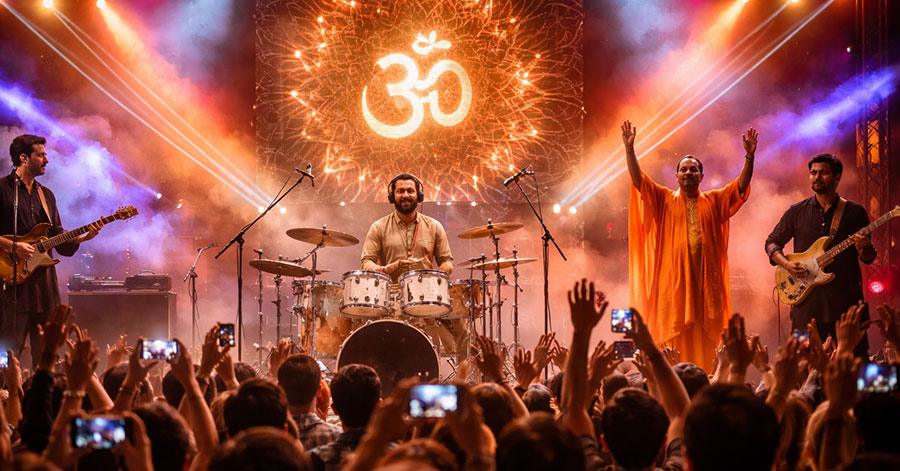
A good kirtan gives the audience something to do. The singer offers a line, the room sings it back, and people who arrived as strangers find themselves keeping time together. The current wave of bhajan clubbing brings that longstanding practice into concert halls and event spaces with contemporary staging and production. In June 2026, Saregama Live and Epitome Live produced Jaya Kishori's Divine Concert at Mumbai's Dome, NSCI, with a live ensemble and concert-scale staging. The audience included children, young professionals and older listeners. In October, Govind Krishna Das's ticketed kirtan at CP67 Mall in Mohali was listed alongside mainstream entertainment on BookMyShow.
A singer such as Anup Jalota can draw on a repertoire people have known for decades. A storyteller such as Jaya Kishori brings an audience accustomed to listening to her in devotional settings. A kirtan artist such as Radhika Das can build a following through gatherings where the audience sings with the performer. Each has a different route to filling a room, and each resembles the creators driving India's booming creator economy. All three can use a recording to introduce the music to someone who may one day buy a ticket.
For venues, the commercial case may be a family audience and a matinee or early-evening slot that is harder to fill with other programming. Promoters have several ways to finance a gathering, from tickets and sponsorship to a commission from a community organisation. A temple festival operates on different terms again. Varanasi's Sankat Mochan Sangeet Samaroh, an annual gathering of classical musicians and dancers at the Sankat Mochan temple, shows how much cultural life the concert market shares with institutions built around worship.
The economics of a ticketed show are especially easy to misread from a full room. Take an illustrative 500-seat event that sells 400 tickets at an average of ?800. It takes in ?3.2 lakh in gross ticket sales before applicable taxes, ticketing charges, artist and crew fees, venue hire, production and promotion. A clip of the crowd singing can travel widely and still tell the promoter very little about the margin, a gap that mirrors the difference between performance marketing and content marketing. Jalota has called the current bhajan-clubbing trend a wave and questioned whether some newer singers have absorbed the music and verse they perform. His criticism also raises a commercial question. Will people come back for a second show when the novelty of the format has worn off?
Live kirtan also travels. London's Eventim Apollo listed a ticketed Radhika Das kirtan in October 2026, and the artist's calendar also lists a multi-day Vrindavan pilgrimage. A recording can be heard across borders at almost no extra effort for the listener. Turning that attention into an event still depends on local communities, venues and people willing to bring their friends. The same artist can be part of someone's morning at home and a reason for that person to gather with others months later.
What a worship app can do with a song
The same bhajan can have a different job on different platforms. On YouTube it can attract a search, a replay or a share. On an audio service it can become part of a saved routine. On a worship app it can sit inside that routine alongside a calendar, darshan and ritual services. Sri Mandir, for instance, puts aartis, bhajans and mantras alongside its panchang and the option to book pujas or arrange offerings at partner temples. The app can earn a repeat visit through music and a transaction through a separate service. Direct channels matter here, which is why WhatsApp rising as a direct brand-to-customer channel is worth watching for festival reminders and katha invitations. The useful product decisions follow from the occasion. A morning queue makes it easier to resume a routine. On-screen lyrics help a family sing together. A festival page can lead from a short clip to a full recording, a katha or a live gathering. Each serves a different reason for opening the app.
What church music can teach the business of bhakti
Christian Copyright Licensing International offers a useful comparison. Its US church licences address specific uses such as projecting copyrighted lyrics, with a separate licence available to livestream church services that feature eligible songs. India has its own legal context, including an exception under Section 52(1)(za) of the Copyright Act for certain uses in bona fide religious ceremonies. The comparison is useful where music travels into distinct commercial uses. A promoter selling access to a concert film or a brand commissioning a soundtrack needs to know which recording it can use, who can authorise that use and who gets paid. A clear answer makes the music easier to license and the revenue easier to trace.
The Tuesday after the festival
The day I would watch is the first ordinary Tuesday after the festival. The stage has come down and the promotion has ended. Somewhere, someone reaches for the same recording they played last week. That is a small act with a long commercial life, provided the recording is easy to find, the people behind it are credited and the rights are clear. A concert can give that listener a place to sing with others. An app can make the recording easier to return to. Both businesses owe something to a ritual people already had a reason to keep.
Comments
No comments yet.
Add Your Comment
Thank you, for commenting !!
Your comment is under moderation...
Keep reading blog post